
Our philosophy is to provide clients with unique and cost-effective
solutions. In doing so, we place great emphasis on knowledge sharing
to ensure we leave clients with the skills, experience and confidence to
carry the results of projects forward.
 Last month, the Automotive Industry Action Group (AIAG) hosted the 2018 Corporate Responsibility (CR) Summit in Michigan, as part of its mandate to streamline an efficient and responsible supply chain among a spectrum of industries. The two-day event showcased information booths and presentations from industry specialists that centered on the Automotive Industry Guiding Principles to Enhance Sustainability Performance in the Supply Chain:
The Global Automotive Sustainability Practical Guidance expands on these principles to outline practical examples within the automotive industry, and how companies can comply with these expectations.
Tanya Bolden, Director, Corporate Responsibility Products and Services for AIAG, commented on the 2018 CR Summit, saying,
“The strategy for this year’s summit was to inform and inspire CR practitioners in the advancement of sustainability practices, encompassed in the tagline: ‘Supply chain sustainability: charting your course for success.’”
The summit was prepared with three audiences in mind:
There is not a lot of regulation in the area of sustainability. “Sustainability” is a dense term that covers a lot of ground, from environmental to social standpoints, both of which are affected by ethics concerning workers and supply chain. Conflict minerals are regulated in the US and Europe, but generally, regulation is driven by the company’s own initiative to reduce their environmental output through reduction strategies, or to comply with customer expectation. Companies measure progress towards sustainability goals through environmental management systems, working with other companies, CDP reporting, and the AIAG reporting initiative to share best practices to elevate the profile and performance of industries.
Few individuals have a “sustainability manager” title, rather, there are environmental managers or health and safety managers with fewer resources down the supply chain, so one person ends up doing everything that falls under the blanket term, “sustainability.” AIAG pulls from the automotive industry, but is issue driven, helping to unfold “sustainability” and meet people where they are with relevant information. The goal of the summit is to identify messages that will resonate with audience across the board and provide breakout sessions for audience members to select based on their expertise and role in their company.
For the past thirty years, AIAG has worked to connect OEMs and suppliers, service providers, and companies for a holistic approach to issues with all stakeholders at the table to create solutions that reduce cost and complexity. AIAG has the unique ability to bring the industry together to evaluate concerns within the supply chain. “Collaboration is at the core of what we do,” says Bolden. With this perspective, there is a role for everyone pursuing ESG (environmental, social, and governance)—the three central factors in measuring a company’s sustainability and ethical impact.
Sandra Tavares, Principal, Tavares Group Consulting Inc., with Mary McDonald of The McDonald Consulting Group, presented practical guidelines for how to integrate environmental, health and safety systems, and sustainability initiatives into a sustainability program that meets all requirements. Tavares and McDonald unpacked the changes and commonalities between ISO 14001 and ISO 45001 management systems, and highlighted significant new concepts in both ISO 14001:2015 and ISO 45001:2018.
“Organizations need a method to consolidate and integrate existing sustainability efforts in order to reduce redundancy and increase efficiency. How you can integrate your organization’s existing management systems?”
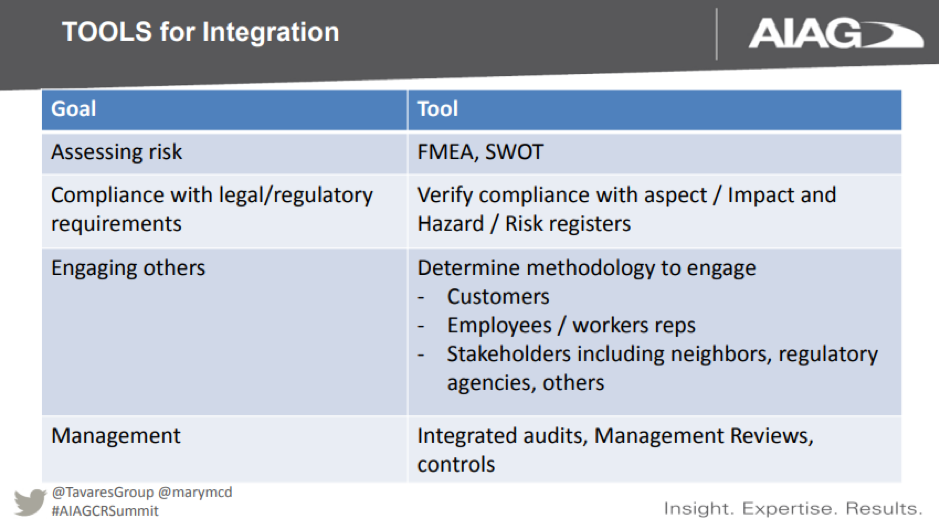
Benefits to your organization from the integration process include a consistent and cohesive business approach to management, one system for all aspects of the business, and a common structure to eliminate duplication. TGC’s sustainability management and reporting software, StaarsoftTM guides organizations, step-by-step, through the process of planning, implementing, and continually improving a comprehensive sustainability program.
 Professor Joe Holt, from the University of Notre Dame, shared how to develop “a better and smarter way to bigger profits.” Sustainability in the automotive industry is particularly important as the global middle class continues to increase, and with it, automobile and other resource use. The situation calls for the highest code of conduct, but as companies each depend on their own handbooks, what exactly are the highest standards of ethics, and how can a company concretely follow them? Most companies focus on risk management and the avoidance of wrongdoing (ethical minimalism), rather than a positive system that reflects and reinforces a higher standard of ethics to achieve excellence in ethical, environmental, social, and financial performance. Holt suggests that a company can aim for a high level of ethical conduct by complying with legal regulations and stakeholder demands, and even going beyond compliance to meet voluntary commitments.
Holt presents four steps to true sustainability:
Turning supply chain risk into opportunity is a topic that Louis Ferretti of IBM Global Procurement addressed in his presentation. Risks from floods to fines to explosions are a major factor in sustainability planning and business growth. According to an IBM study, supply chain visibility is inhibited both by a lack of timely data and an overabundance of indigestible data. Process, data, and technology are roadblocks to good risk management, yet are also its driving forces. IBM Global Procurement manages risk types such as supply continuity, legal and regulatory, reputation, and IT security in response to ISO 14001:2015 to protect corporate supply chains and assist in sustainability methods.
 Axalta Coating Systems, represented by Matthew Winokur, Vice President, Sustainability and the Responsible Mica Initiative, with Riaz Zamam, Board Member, and Government Affairs Counsel, partnered to address the mica supply chain in India. Mica is a natural resource used in industries ranging from paints and automotive, to electronics and cosmetics. The demand for mica is predicted in increase. The official production of mica in India is 20 kilotonnes, while 128 kilotonnes are recorded as annual exports from India, two thirds of which goes to China. 75% comes from Bahir and Jharkhand, where locals experience extreme economic and social challenges due to informal (unrecorded) mica collection. Child labour is often employed to mine mica for the automotive and cosmetics industries, sometimes leading to injury and death. Rather than avoid the risks associated with mica supply, Terre de Hommes, a Swiss non-profit dedicated to helping children across the globe, advises companies to “use their leverage, rather than simply leaving a high-risk situation, opting out by using synthetic mica, or circumventing risk countries.” There is opportunity to improve the mica mining industry by supporting fair and traceable suppliers, complying with local governments, and empowering local villages. As awareness spreads, more companies are joining the Responsible Mica Initiative to ensure ethical mica mining in their supply chain.
Other insightful presentations at the AIAG CR Summit included a session with Eric Whan from GlobeScan, Marshall Chase of the AIAG Future of CR Report, and Holly Duckworth of Kaiser Aluminum, on integration of sustainability, ethics, and business and the examination of industry trends and projections; a panel with Meghan Ryan, BSR Associate Director, on how to evaluate supply chain and corporate responsibility within your program; and a big picture look at sustainability via innovation with John Pittenger of Koch Industries, Inc. and Brad McKenna of Robert Bosch LLC.
Tavares Group Consulting offers customizable and scalable solutions to assist organizations pursue corporate sustainability and sustainable development. Our Corporate Social Responsibility (CSR) services include gap analysis/benchmark assessments, sustainability action planning and implementation, Corporate Responsibility and sustainability reporting, and assurance services. For more information on how we can assist your organization meet its CSR goals, contact us!